
Physics: Grade 11 11 Sections62 LessonsLifetime
1.4. The Mission of Physics and Career Awareness
Physics Grade 11
Lesson Competencies
At the end of the lesson you will be able to:
Explain the fundamental mission of physics.
Identify a wide range of career fields that utilize physics principles.
Describe the roles of physicists in sectors like healthcare, technology, and energy.
Recognize how a background in physics can lead to diverse job opportunities.
Key Terms
Physicist
A scientist who specializes in the field of physics, focusing on the fundamental principles of energy, matter, space, and time.
Astrophysics
A branch of astronomy that employs the principles of physics to study the nature of celestial objects and the universe.
Medical Physics
The application of physics concepts and methods to the diagnosis and treatment of human disease (e.g., MRI, radiation therapy).
Geophysics
The study of the physical properties of the Earth and its surrounding space environment, using principles of physics.
Video Lesson
Physics: Unlocking the Universe and Your Career
Have you ever looked at your smartphone, a towering skyscraper, or the stars in the night sky and wondered, “How does all of this work?” The answer, at its core, lies in physics. Physics is much more than equations on a blackboard; it’s the fundamental operating system of our universe.
The Grand Mission of Physics
The primary mission of physics is to understand the fundamental principles that govern the universe. Physicists seek to answer the biggest questions: What is the universe made of? How did it begin? What are the basic forces of nature? By studying everything from the tiniest subatomic particles to the largest galaxies, physicists build models and theories that explain how everything interacts. This quest for knowledge drives innovation and shapes our understanding of reality itself.
From Theory to Reality: Careers in Physics
A degree in physics doesn’t just train you to be a professor. It equips you with powerful problem-solving, analytical, and quantitative skills that are in high demand across countless industries. Let’s explore some of the exciting career paths a physics education can open up.
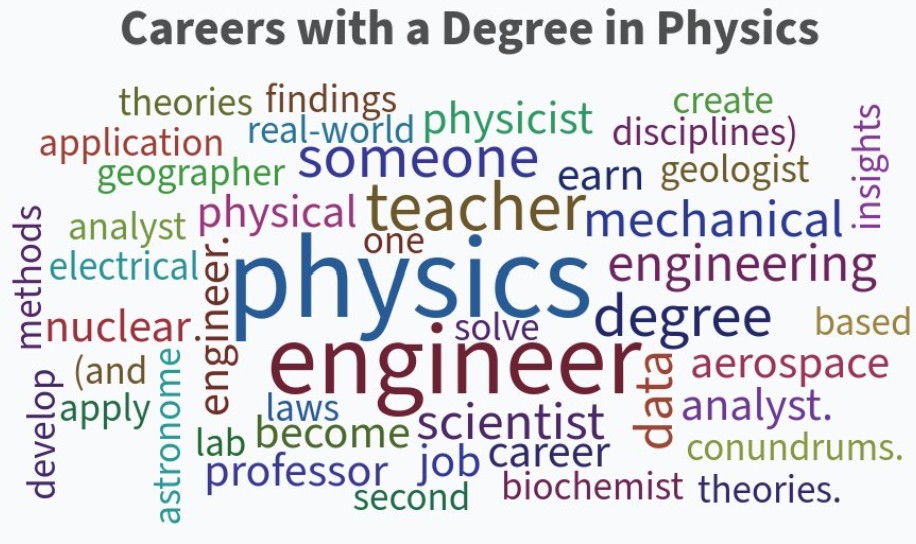
Physicists work in labs, hospitals, tech companies, and even space agencies.
Space and Astronomy
An astrophysicist might study black holes, while an aerospace engineer could use mechanics and thermodynamics to design spacecraft for NASA or SpaceX.
Healthcare
Medical physicists are vital to modern medicine. They develop and maintain imaging equipment like MRI scanners and design radiation treatments for cancer patients.
Engineering
A mechanical engineer uses principles of motion to design engines, while an electrical engineer applies knowledge of electromagnetism to create power grids.
Energy
From developing efficient solar panels (renewable energy scientist) to ensuring the safety of nuclear power plants (nuclear physicist), physicists solve the world’s energy challenges.
Technology
Semiconductor physicists work on creating faster computer chips, while materials scientists develop new materials like flexible screens or stronger alloys.
Geophysics and Meteorology
A geophysicist might use seismic waves to explore for oil or study earthquakes. A meteorologist applies thermodynamics and fluid dynamics to forecast the weather.
Research and Academia
Many physicists become research scientists at universities or national labs (like CERN), pushing the boundaries of human knowledge and teaching the next generation.
Power-up Activity: Career Pathfinder
Read the scenario and choose the best physics professional for the job!
Activity 1: Identify the Physicist
1. A scientist who uses the principles of physics to study stars, planets, and galaxies is called a(n):
2. Which career directly applies physics to design radiation therapy for cancer patients?
3. A professional who studies earthquakes and explores for natural resources using seismic waves is a:
4. Developing new, more efficient solar panel technology would most likely be the job of a:
5. What is the fundamental mission of physics?
Activity 2: Match the Career to the Task
Drag the physics career to the description of the task they would perform.
Careers
Tasks
Activity 3: Mixed Challenge
1. True or False: A degree in physics only prepares you for a career as a teacher or university professor.
2. The branch of physics that applies its principles to the diagnosis and treatment of disease is called .
3. Which of these fields relies heavily on the physics of thermodynamics and fluid dynamics?
4. True or False: Physics knowledge is essential for all branches of engineering.
5. A physicist studying the basic building blocks of matter at a particle accelerator like CERN would be called a .
Lesson Summary
The mission of physics is to explore and understand the fundamental laws of the universe, from the smallest particles to the largest galaxies.
This fundamental knowledge is not just academic; it’s the driving force behind technological and societal advancement.
A background in physics develops critical thinking and problem-solving skills, opening doors to a vast array of careers in engineering, healthcare, technology, energy, space exploration, and more.
Studying physics provides a versatile foundation for innovating and solving some of the world’s most pressing challenges.
Final Assessment
1. Creating a new, more durable material for a smartphone screen would be a task for a:
2. Which career path is LEAST likely for someone with a physics degree?
3. The operation of MRI and CT scanners in hospitals is overseen by a:
4. The analytical and problem-solving skills learned in physics are valuable in:
5. What connects the work of an astrophysicist, a materials scientist, and a geophysicist?
Competency Checklist
Review the competencies and check off the ones you feel confident about.