
Physics: Grade 11 11 Sections62 LessonsLifetime
1.3. The Making of Physics Knowledge
Physics Grade 11
Lesson Competencies
At the end of the lesson you will be able to:
Differentiate between experiential and non-experiential knowledge.
Identify sources of a posteriori knowledge like perception, introspection, memory, and testimony.
Describe the systematic process of the scientific method.
Explain each step of the scientific method: Observation, Question, Research, Hypothesis, Experiment, Analysis, and Conclusion.
Apply the scientific method to a simple physics problem.
Key Terms
A Posteriori Knowledge
Knowledge derived from experience or empirical evidence. It is also known as experiential knowledge.
Scientific Method
A systematic procedure for collecting and analyzing evidence to test ideas and answer questions.
Hypothesis
A testable, educated guess or prediction about the relationship between variables.
Sensory Perception
The process of acquiring information about the world through the five senses: sight, sound, smell, taste, and touch.
Video Lesson
Core Lesson: The Foundation of Physics Knowledge
Dear learners,
Have you ever wondered how we know that the Earth revolves around the Sun, or why a ball thrown in the air always falls back down? Physics is not just a collection of facts; it’s a way of thinking and a process of discovery. We build our understanding of the universe through careful observation and logical reasoning.
Today, we will explore how physicists construct knowledge. We’ll see that knowledge comes from different sources and that we need a reliable system, the scientific method, to separate fact from fiction.
Two Major Types of Knowledge
In science, we primarily deal with two fundamental ways of knowing things.
1. Experiential (A Posteriori) Knowledge
This is knowledge that comes directly from our experiences and observations of the world. It’s based on evidence. Most of scientific knowledge is a posteriori. We gain it through several channels:
- Sensory Perception: What you see, hear, touch, taste, and smell. For example, seeing that a blue liquid and a yellow liquid mix to make a green one.
- Introspection: Understanding your own mental states, like feeling confident or confused about a physics concept.
- Memory: Recalling past experiences, like remembering the result of an experiment you performed last week.
- Testimony: Gaining knowledge from other sources, like reading a textbook, listening to a teacher, or watching a documentary. We rely on the testimony of countless scientists who came before us.
2. Non-Experiential (A Priori) Knowledge
This is knowledge that is independent of experience. It is based on reason, logic, and definitions. Mathematical truths ((1+1=2)) and logical statements (“All triangles have three sides”) are examples of a priori knowledge. This type of knowledge is crucial in physics for building theories and making logical deductions.
The Scientific Method: A Blueprint for Discovery
The scientific method is a structured path from a question to a conclusion.
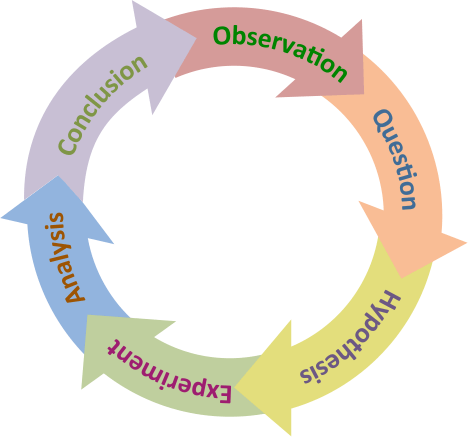
Step 1: Observation
It all starts with noticing something. You drop your pen, and it falls. You see the sun rise in the east and set in the west. This is the spark that ignites curiosity.
Step 2: Question
Your observation leads to a question. Why did the pen fall down instead of up? Why does it always fall at the same rate?
Step 3: Research
Find out what is already known about your question. Read books, articles, and scientific papers. This prevents you from “reinventing the wheel” and helps you form a good hypothesis.
Step 4: Hypothesis
Formulate a testable explanation. A good hypothesis is a specific “if… then…” statement. For example: “If I drop a heavy ball and a light ball from the same height, then they will hit the ground at the same time (ignoring air resistance).”
Step 5: Experiment
Design and conduct a controlled experiment to test your hypothesis. You must identify your variables: the independent variable (what you change), the dependent variable (what you measure), and controlled variables (what you keep the same).
Step 6: Analysis
Collect and analyze your data. Record your measurements in tables and visualize them using graphs. Look for patterns, trends, and relationships. Does the data support or reject your hypothesis?
Step 7: Conclusion
Summarize your findings. State whether your hypothesis was supported or refuted by the evidence. If it was refuted, you might need to revise your hypothesis and test again. This is not a failure; it’s part of the process! Finally, communicate your results to others.
Example: The Pendulum
Let’s apply the scientific method to a simple pendulum.
- Observation: A child on a swing moves back and forth. Some swings seem faster than others.
- Question: What factor affects the time it takes for a pendulum to complete one swing (its period)? Is it the mass on the end, the length of the string, or how far back you pull it?
- Research: Read about pendulums and simple harmonic motion. Learn that the period might be related to its length.
- Hypothesis: If the length of a pendulum string is increased, then its period will also increase.
- Experiment:
- Independent Variable: Length of the string.
- Dependent Variable: Period (time for 10 swings, then divide by 10).
- Controlled Variables: Mass of the pendulum bob, starting angle.
- Procedure: Measure the period for several different string lengths (e.g., 20 cm, 40 cm, 60 cm, 80 cm), repeating each measurement three times for accuracy.
- Analysis: Plot a graph of Period vs. Length. You will find that the period increases as the length increases. The relationship is not linear; it is ( T propto sqrt{L} ), where (T) is the period and (L) is the length. The full formula is ( T = 2pisqrt{frac{L}{g}} ).
- Conclusion: The data supports the hypothesis. The period of a simple pendulum is determined by its length, not its mass or release angle (for small angles).
Virtual Lab: Pendulum Lab
Use this simulation to test the hypothesis from our example. Change the length, mass, and gravity, and observe the effect on the pendulum’s period.
Activity 1: Check Your Understanding
1. Knowledge gained through direct experience, like touching a hot stove and learning it burns, is called:
2. What is the very first step in the scientific method?
3. A testable, educated guess is known as a(n):
4. Reading a physics textbook to learn about Newton’s Laws is an example of acquiring knowledge through:
5. In an experiment, the factor that you purposely change to see its effect is the:
Activity 2: Sequence the Scientific Method
Drag the steps of the scientific method and drop them into the correct order.
Available Steps
Correct Order
Activity 3: Fill in the Blanks
1. The systematic, step-by-step process for discovering knowledge about the natural world is called the .
2. Knowledge that is based on logic and reason, independent of experience, is known as knowledge.
3. After forming a question, a scientist should conduct to see what is already known.
4. During an experiment, the variable that is measured or observed is the .
5. The final step of the scientific method, where you state if your hypothesis was supported, is the .
Lesson Summary
Physics knowledge is built upon two main foundations: experiential (a posteriori) knowledge, gained through observation and experience, and non-experiential (a priori) knowledge, based on logic and reason.
Sources of experiential knowledge include sensory perception, introspection, memory, and testimony from others.
The scientific method is the essential, systematic process used to validate and expand our knowledge. It provides a reliable framework for moving from observation to a well-supported conclusion.
The seven key steps are: Observation, Question, Research, Hypothesis, Experiment, Analysis, and Conclusion.
Final Assessment
1. True or False: A scientific law is a hypothesis that has been proven true beyond any doubt.
2. A scientist is studying how the angle of a ramp affects the speed of a rolling ball. What is the dependent variable?
3. Which of the following is NOT a good scientific hypothesis because it is not testable?
4. “All bachelors are unmarried men” is an example of what kind of knowledge?
5. If an experiment’s results do not support the hypothesis, what is the best next step?
Competency Checklist
Review the competencies and check off the ones you feel confident about.