
Geography: Grade 9 12 Sections48 Lessons365 Days
1.3. Geologic History of Ethiopia
Geologic History of Ethiopia
Geography Grade 9
Lesson Competencies
At the end of the lesson you will be able to:
Describe the major geologic processes that shaped Ethiopia and the Horn of Africa.
Identify the key events and characteristics of the Precambrian, Paleozoic, Mesozoic, and Cenozoic eras in Ethiopia.
Explain the formation of different rock types and landforms in Ethiopia over geologic time.
Relate major geological events to the emergence of different life forms.
Key Terms
Orogenic Movements
Mountain-building processes, often involving volcanic activity and the folding of the Earth’s crust.
Denudation
The process of wearing down and stripping away the Earth’s surface by forces like wind and water.
Peneplanation
The leveling of a land surface to a nearly flat plain, which is the final stage of denudation.
Epeirogenesis
The slow, large-scale vertical movements of the Earth’s crust, causing gradual uplifting or sinking of landmasses without significant folding.
Video Lesson
Core Lesson: Ethiopia’s Deep Past
Dear learners,
Have you ever looked at a mountain, a deep gorge, or the flat plains and wondered, “How did this get here?” The land beneath our feet has a story that is billions of years old. It’s a tale of fire, ice, immense pressure, and slow, constant change.
Today, we will travel back in time to uncover the Geologic History of Ethiopia. We’ll explore the ancient processes that built our mountains, carved our valleys, and laid down the rocks that make up our homeland. Think of it as being a detective, piecing together clues from the past to understand the Ethiopia we see today.
The Four Great Eras
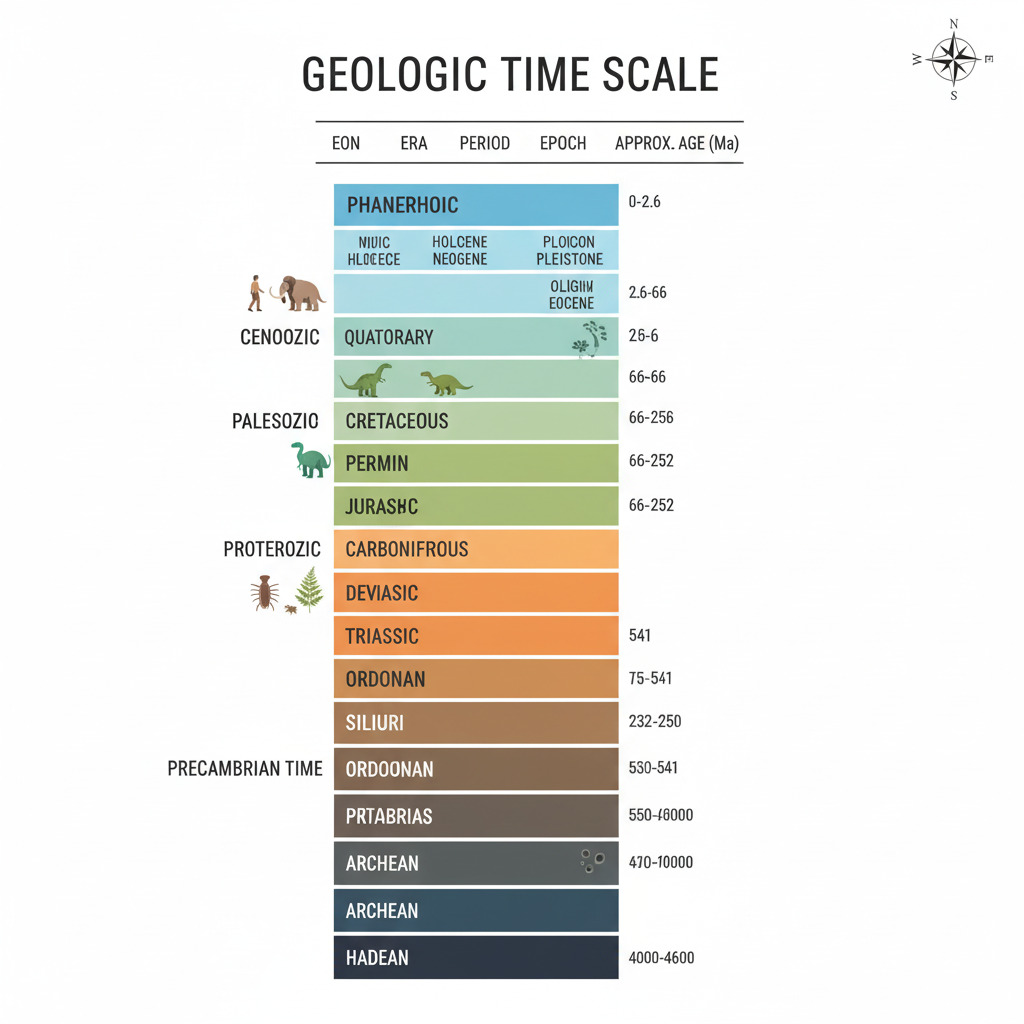
Geologists divide Earth’s history into four major eras. We’ll explore what happened in Ethiopia during each one.
1. The Precambrian Era (4.6 Billion – 600 Million Years Ago)
This is the Earth’s “basement” era, the oldest and longest period. During this time, the very foundation of Ethiopia was laid. Key events include:
- Formation of Basement Rocks: The oldest rocks, known as the old crystalline basement complex, were formed. These rocks are found beneath all other layers.
- Mountain Building: Frequent and intense orogenic movements (mountain building) occurred, creating massive volcanic mountain ranges.
- Denudation: Over millions of years, these mountains were worn down through denudation, leaving behind a leveled surface.
- First Life: The very first, simple forms of life, like amoeba and jellyfish, emerged in the oceans.
- Where to find these rocks: In Ethiopia, you can find these ancient rocks in central and northern Tigray, Mettekel, Assossa, Illubabor, and the Abbay Gorge.
2. The Paleozoic Era (600 – 250 Million Years Ago)
This era is known as Ethiopia’s “lost” chapter. Not much happened in terms of rock formation. It was a long, quiet period of stability and erosion.
- Peneplanation: The main process was continued denudation and peneplanation, which created a vast, almost flat plain across the land.
- Gap in the Record: Because of this erosion, this era left a significant gap in Ethiopia’s rock record. No major new rocks were formed.
- Inselbergs: Some very resistant rocks survived the erosion, leaving behind isolated hills called Inselbergs.
- Life: This era was dominated by invertebrates (animals without backbones) in the seas.
3. The Mesozoic Era (250 – 70 Million Years Ago)
This was a time of great change, often called the “Age of Reptiles.” The land of the Horn of Africa began to sink and rise slowly.
- Sinking Land: A process called epeirogenesis caused the land to slowly sink, allowing the sea to cover it.
- Sedimentary Rocks: As the sea advanced and retreated over millions of years, it left behind layers of sand and mud that hardened into sedimentary rocks. These are known as Adigrat Sandstone (oldest), Hintalo Limestone, and Upper Sandstone (youngest).
- Age of Dinosaurs: This era was dominated by huge reptiles like dinosaurs. At the end of the era, mammals, birds, and flowering plants began to emerge.
4. The Cenozoic Era (70 Million Years Ago – Present)
This is the most recent era and the one that truly shaped modern Ethiopia. It was a period of dramatic geological activity.
- Tertiary Period:
- Uplifting of the Ethiopian Highlands.
- Intense volcanic activity led to the formation of the Trap Series volcanics, thick layers of lava that cover large parts of the highlands.
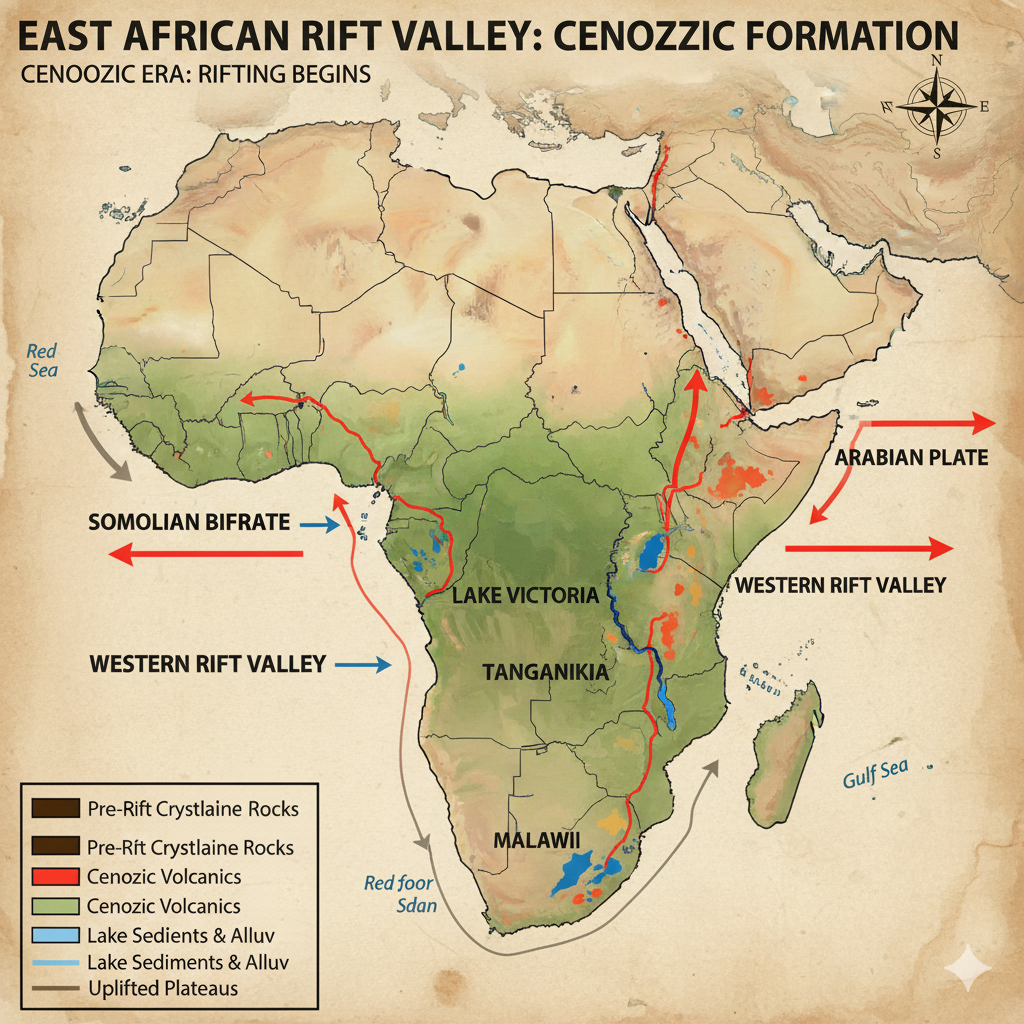
- The creation of the Great Rift Valley began as the African plate started to split apart. This created the escarpments and valleys we see today.
- Quaternary Period:
- Continued volcanic activity, especially in the Rift Valley, formed the Aden Series or Quaternary volcanics.
- Periods of heavy rainfall filled the Rift Valley, creating large lakes.
- Deposition of alluvial and lake sediments occurred in various lowlands.
- Modern humans emerged during this period.
Activity 1: Check Your Knowledge
Activity 2: Fact or Fiction?
Activity 3: Complete the Sentence
Lesson Summary
Ethiopia’s geologic history is a long and dynamic story told in four parts. The Precambrian Era gave us our foundation—the ancient basement complex rocks.
The Paleozoic Era was a quiet time of erosion, leaving a gap in our rock record. The Mesozoic Era saw the land sink, allowing the sea to deposit layers of sedimentary rock.
Finally, the Cenozoic Era was a time of intense volcanic activity and tectonic movement, which lifted the Ethiopian Highlands and created the Great Rift Valley, shaping the landscape we know today.
Final Assessment
Competency Checklist
Check off the skills you’ve mastered in this lesson.