
English: 7th grade 14 Sections44 Lessons365 Days
1.2. Reading and Vocabulary lesson
Life in Rural Ethiopia
English Seventh Grade
Lesson Competencies
At the end of the lesson you will be able to:
Comprehend ideas and facts about the economic and cultural life of rural Ethiopians.
Analyze the main message (thesis) of a passage about rural life.
Guess the meaning of new vocabulary words from the context of a passage.
Compare and contrast the activities in the passage with your own life experiences.
Use new vocabulary words correctly in sentences.
Key Terms
Livelihood
The way someone earns the money or gets the food needed to live.
Subsistence Farming
When a family grows just enough food to feed themselves, but not extra to sell.
Communal
Something that is shared by all members of a community; for common use.
Bartering
Exchanging goods or services for other goods or services, without using money.
Harvest
The process or period of gathering in crops.
Artisan
A worker in a skilled trade, especially one that involves making things by hand.
Pre-Reading Activities
Dear learners,
Think about where your food comes from. If you live in a city like Addis Ababa, you probably buy it from a shop or a market. But where does the shopkeeper get it from? Many people in Ethiopia live in the countryside and grow the food that everyone eats. Their daily life, culture, and work are very different from life in a big city.
Brainstorming Scenario
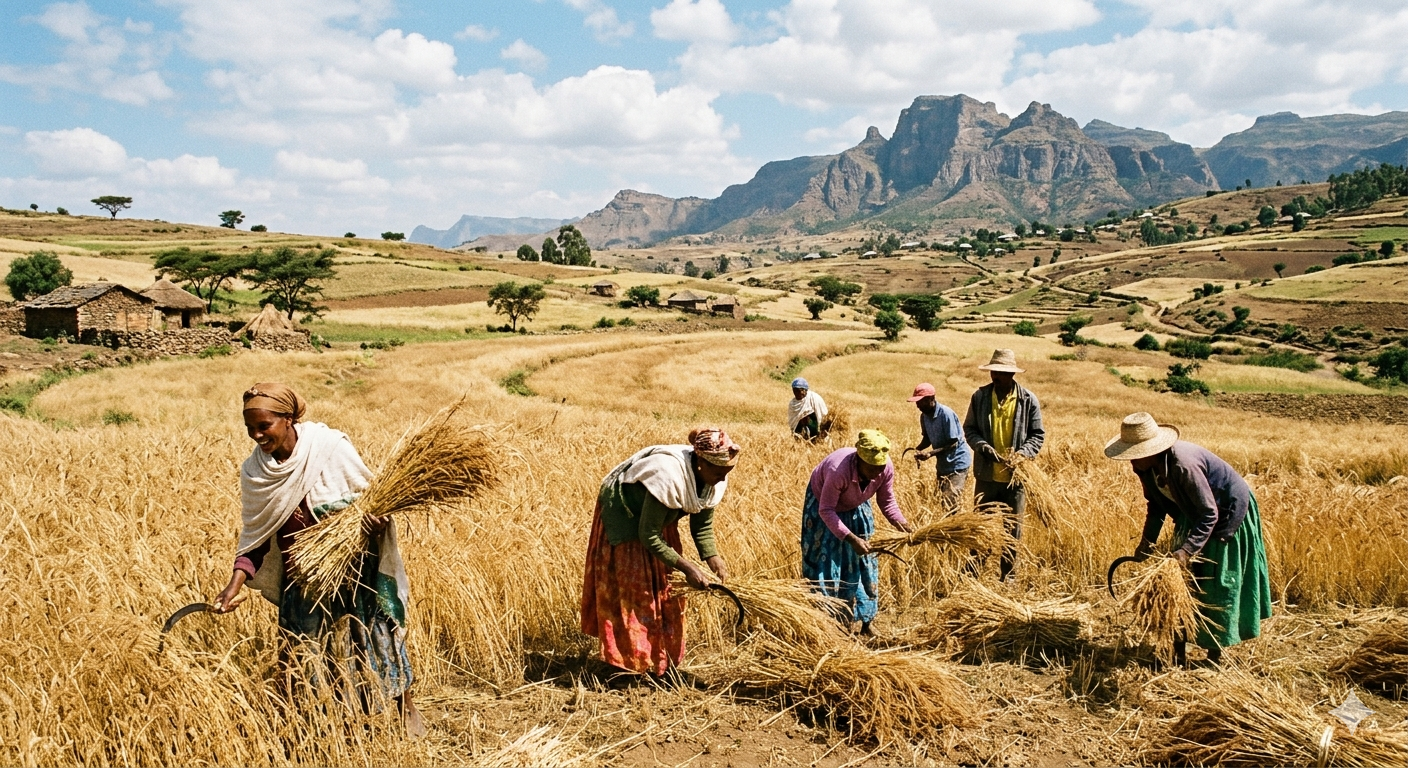
Imagine a family working together in the fields to gather their crops. What sounds would you hear? What would the air smell like? How is this different from your daily routine?
Before You Read
As you read the following passage, think about these questions:
- What is the main way the family in the story gets their food?
- How do neighbors help each other in the village?
- What is the main idea or message of the passage?
Reading Comprehension
Read the passage about life in a rural village and answer the questions that follow.
Passage: A Day with Abebe
Twelve-year-old Abebe lives in a small village surrounded by green fields of teff. His family’s livelihood depends entirely on the land. They practice subsistence farming, which means they grow most of their own food. Every morning, Abebe helps his father in the fields before going to school. His mother and older sister, Fatuma, manage the household, prepare food, and fetch water from the communal well.
The time of the harvest is the busiest but also the most joyful. It is a communal effort; neighbors help each other to gather the crops quickly. They sing traditional songs as they work, making the hard labor feel lighter. Afterward, families share big meals and celebrate with coffee ceremonies. Although they don’t have much money, they have strong bonds. At the weekly market, Abebe’s father is sometimes bartering, trading a sack of teff for salt or cooking oil. This way of life, built on cooperation and connection to the land, is the heart of their culture.
Vocabulary Practice
Use your knowledge of the key terms and the reading passage to answer the questions.
Lesson Summary
The livelihood of many rural Ethiopians is based on farming, often subsistence farming.
Life in rural villages is often communal, with people helping each other, especially during the harvest.
Instead of money, bartering is sometimes used in markets to trade for necessary goods.
The culture is built on strong family bonds, cooperation, and a deep connection to the land.
Skilled workers who make things by hand, like pots or clothes, are called artisans.
Final Assessment
Read this new passage and answer the questions.
Passage: Hanna the Potter
While farming is the main work in the village, some people have other skills. Abebe’s neighbor, Hanna, is an artisan. She is a potter who makes beautiful clay jebenas (coffee pots) and dishes. She learned the skill from her mother, just as her mother learned it from her grandmother. Hanna doesn’t have a modern factory; she finds her own clay near the river and shapes each pot by hand. Her work is important for the village. Families use her jebenas for their daily coffee ceremonies. When traders come from the city, they admire her work. Sometimes she trades her pots for colorful threads that she uses to decorate her clothes. Hanna’s craft is not just a job; it is a proud tradition that serves her community and preserves a part of their cultural heritage.
Competency Checklist
Check off each competency as you master it: