
Maths: Year 6 17 Sections37 Lessons365 Days
4.1 Positive and negative integers
Positive and Negative Integers
Math Year 6 – Cambridge Curriculum
Lesson Competencies
At the end of the lesson you will be able to:
Understand the meaning of a positive number and a negative number.
Estimate, add, and subtract large integers.
Add and subtract combinations of positive and negative integers.
Find the mathematical difference between two integers in real-world contexts.
Key Terms
Integer
A whole number that can be positive, negative, or zero. Examples: -5, 0, 12.
Negative Number
A number less than zero. Written with a minus sign, like -3. Represents things like freezing temperatures or debt.
Positive Number
A number greater than zero. Often written without a sign, like 7 or +7. Represents height or saving money.
Difference
The result of subtracting one integer from another, or the distance between them on a number line.
Core Lesson: Navigating the Number Line
Introduction
Dear learners,
Have you ever wondered how to measure something that is below zero? Imagine you are climbing the highest peak in Ethiopia, Ras Dashen, and then traveling down to the Danakil Depression, one of the lowest and hottest places on Earth!
Brainstorming Scenario
If the temperature in Addis Ababa is 15°C during the day, and it drops by 20°C at night, how cold is it? We need numbers less than zero to answer this! We need a negative number.
Understanding Integers
An integer is any whole number. It can be a positive number (greater than zero), a negative number (less than zero), or zero itself.
… -4, -3, -2, -1, 0, 1, 2, 3, 4 …
The Number Line
- Moving right on the number line means adding (numbers get bigger).
- Moving left on the number line means subtracting (numbers get smaller).
Adding and Subtracting
1. Adding a Positive
Means moving RIGHT.
Example: ( -3 + 5 = 2 )
Start at -3, move right 5 spaces.
2. Adding a Negative
Is the same as subtracting! Move LEFT.
Example: ( 4 + (-6) = 4 – 6 = -2 )
3. Subtracting a Negative
Taking away a negative is like adding a positive. The two negatives cancel out to make a plus! Move RIGHT.
Example: ( 5 – (-3) = 5 + 3 = 8 )
Video Lesson
Real-World Examples
Local Ethiopian Context
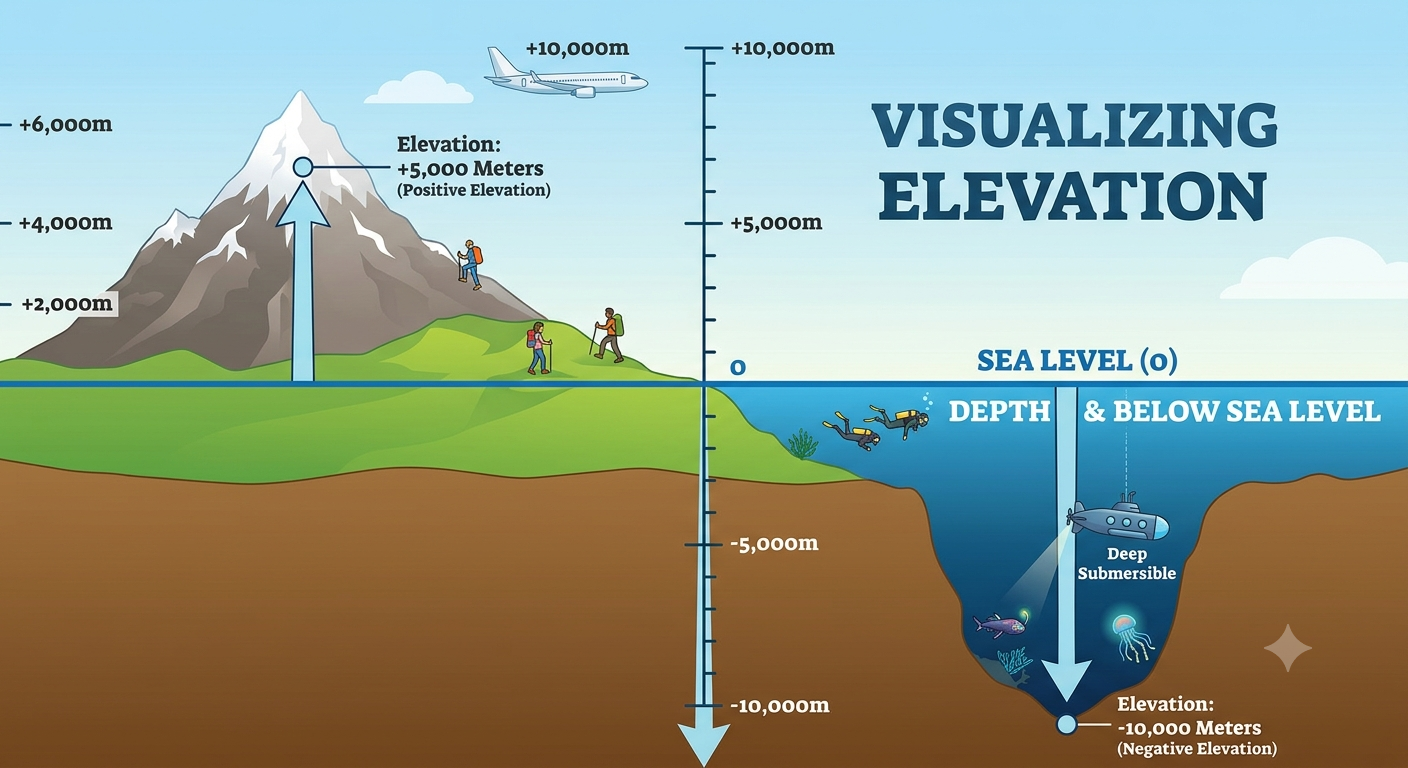
Ras Dashen has an elevation of +4550 meters. The Danakil Depression is at -125 meters. What is the total difference in elevation between these two places?
Difference = 4550 – (-125) = 4550 + 125 = 4675 meters
International Context
In Moscow, the temperature in the morning was -8°C. By afternoon, it warmed up by 12°C. What was the afternoon temperature?
New Temp = -8 + 12 = +4°C
Integer Tile Flip Game
Solve the equations to reveal the hidden picture of Ras Dashen!
Question
Activity 1: Integer Operations (MCQ)
Activity 2: Tap-to-Sort Integers
How to play: Tap a number below to select it, then tap the correct box to place it.
Numbers to Sort
Negative Numbers (< 0)
Positive Numbers (> 0)
Activity 3: True or False Challenge
Lesson Summary
An integer is a whole number that can be positive, negative, or zero.
Adding a negative number is the same as subtracting (move left on number line).
Subtracting a negative number is the same as adding (move right on number line).
The difference between two temperatures or elevations is found by subtracting them.
Final Assessment
Test your knowledge to complete the lesson!
Self-Assessment Checklist
Check off the skills you feel confident about: