
History: 9th Grade 13 Sections70 Lessons365 Days
1.4 Theories of Human Evolution
Theories of Human Evolution
History – Grade 9
Lesson Competencies
At the end of the lesson you will be able to:
Explain the major theories of human evolution.
Describe Charles Darwin’s concept of natural selection.
Identify key hominid fossils discovered in Ethiopia.
Understand why Ethiopia is referred to as the Cradle of Mankind.
Key Terms
Evolution
The scientific theory explaining how living things change gradually over millions of years.
Hominid
Early human ancestors that walked upright on two legs (bipedalism).
Fossils
The preserved remains or traces of ancient organisms, found in rocks or soil.
Paleoanthropology
The scientific study of human evolution through the discovery and analysis of fossil remains.
Video Lesson: The Cradle of Humankind
Watch this overview of Ethiopia’s rich paleoanthropological history.
Core Lesson: Our Origins
Introduction
Dear learners,
Imagine walking through the hot, dry terrain of the Awash Valley in Ethiopia. Beneath your feet lies the history of all humanity! For centuries, people have asked: Where do we come from? Today, we will explore the major theories that answer this profound question.
1. The Creationist Theory
Before modern science, most people relied on the Creationist Theory. This belief suggests that a Supreme Being (God) created the universe, the earth, and all living things, including humans, in their present form. These beliefs are deeply rooted in religious texts and traditional cultural stories across the world.
2. The Scientific Theory of Evolution
In the 19th century, scientists began to study fossils and nature closely. The most famous was Charles Darwin, an English naturalist. In 1859, he published a book called “On the Origin of Species”. Darwin proposed the theory of Natural Selection.
Natural Selection means that living organisms best adapted to their environment are more likely to survive and reproduce. Over millions of years, these small adaptations led to the development of new species—including human beings evolving from ape-like ancestors.
Ethiopia: The Cradle of Mankind
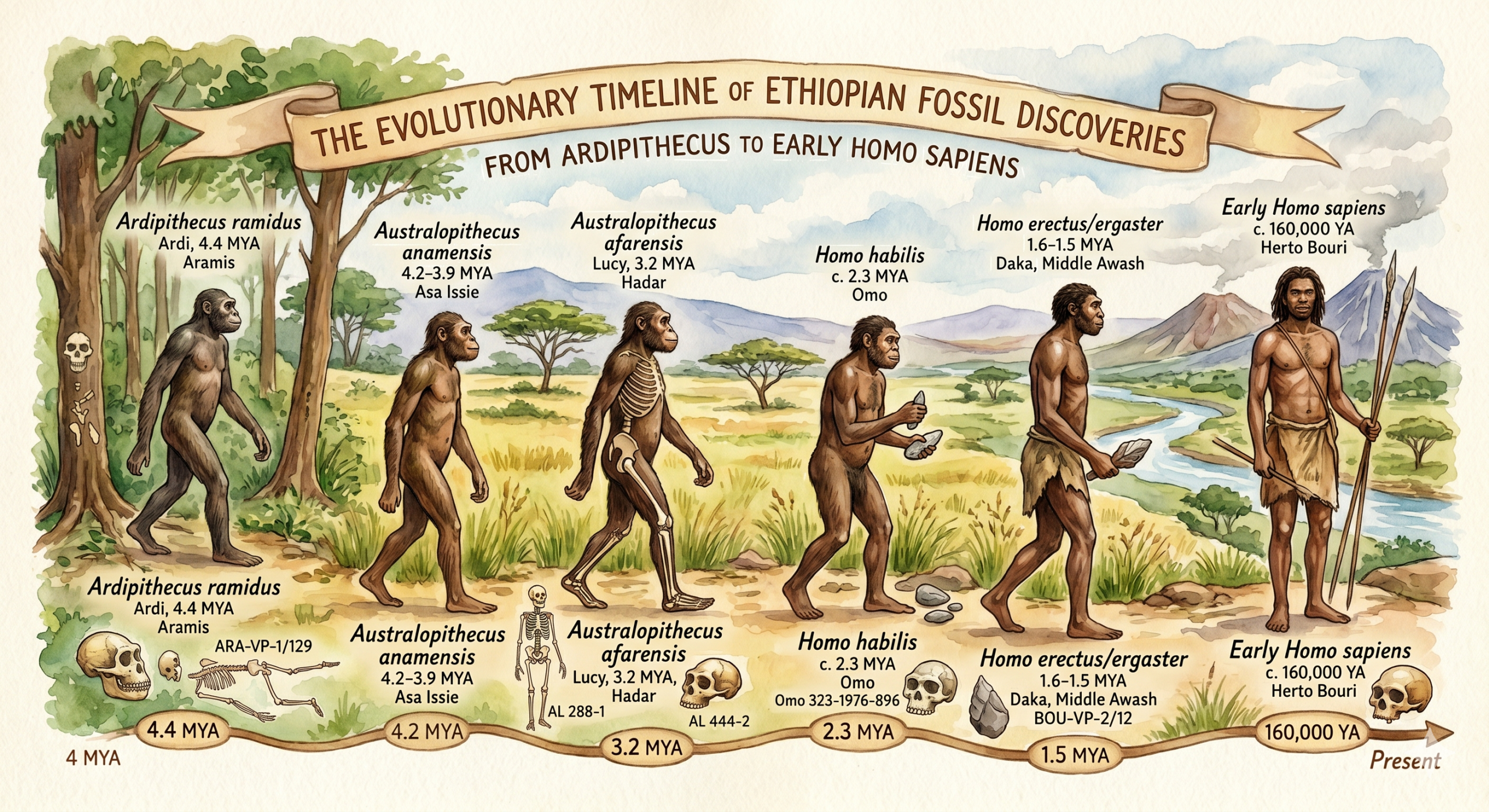
Ethiopia holds a special place in history. It is widely considered the birthplace of humanity because some of the oldest and most complete hominid fossils have been discovered here, particularly in the Afar region.
1. Ardi (Ardipithecus ramidus)
Discovered in 1994 in the Aramis area of the Middle Awash. Ardi lived about 4.4 million years ago. She reveals that early ancestors could walk upright but also spent time in trees.
2. Lucy / Dinknesh (Australopithecus afarensis)
Discovered in 1974 by Donald Johanson in Hadar. Lucy (known as Dinknesh in Amharic, meaning “You are marvelous”) lived about 3.2 million years ago. Her nearly complete skeleton proved that early hominids walked on two legs before their brains grew large.
3. Selam (The Dikika Baby)
Discovered in 2000 in Dikika. This fossil is the incredibly well-preserved skeleton of a 3-year-old Australopithecus afarensis child, older than Lucy, dating back 3.3 million years.
Visualizing Our Ancestors
Activity 1: The Great Fossil Match
Tap a fossil name, then tap the correct description box to place it! (Or drag and drop).
Hominids & Fossils
Descriptions
4.4 Million Years Old (Aramis)
3.2 Million Years Old (Hadar)
3.3 Million Years Old (3-year-old child)
Proposed the Theory of Natural Selection
Activity 2: Multiple Choice
1 / 5Activity 3: True or False
1 / 5Activity 4: Mixed Challenge
1 / 5Lesson Summary
Creationist Theory attributes the origin of life to a Divine Creator, while the Evolutionary Theory (proposed by Charles Darwin) relies on scientific evidence and Natural Selection.
Ethiopia is globally recognized as the Cradle of Mankind due to profound fossil discoveries in the Awash Valley.
Key fossils include Ardi (4.4 million years old) and Lucy / Dinknesh (3.2 million years old), who provided evidence that upright walking (bipedalism) preceded large brain development.
Final Assessment
1 / 5Competency Checklist
Self-assess your learning. Check the boxes if you can do the following: