
Fable
A short traditional story, usually with animals as characters, written to teach a clear lesson. Example: Aesop’s tale of The Fox.
Cambridge International Curriculum
English Year 5 • Aesop’s Fables & Figurative Language
By the end of this Reading and Vocabulary lesson, you will be able to:
Study these essential words and expressions before you begin reading. Notice the icons and British examples to help you remember each term.
A short traditional story, usually with animals as characters, written to teach a clear lesson. Example: Aesop’s tale of The Fox.
A practical lesson about right and wrong behaviour taught by a story. Example: Honesty is always the best policy.
A short, well-known saying that gives wise advice or states a general truth. British example: “A stitch in time saves nine.”
A widely held, fixed, and oversimplified idea about a group of people or animals. Example: Assuming every fox is a sly trickster.
Also called an idiomatic expression or figurative expression. A phrase whose overall meaning is different from the literal dictionary meanings of its words. British example: “It’s raining cats and dogs in Manchester!”
Relating to people. In fables, animals are given human feelings, speech, and habits—such as vanity, pride, or patience—to help readers learn a lesson.
Dear learners,
Imagine you are tucked up inside a stone cottage in the Yorkshire Dales on a drizzly autumn afternoon. With a warm mug of English breakfast tea beside you and a plate of buttery crumpets, you open an illustrated book of ancient stories. Over 2,500 years ago, a famous storyteller named Aesop told clever, memorable tales to teach people wise lessons about how to live.
Stories do more than entertain us—they help us reflect on our choices. Today, we will read two of Aesop’s timeless fables reimagined in classic British settings.
As you read the first passage, watch closely for our Key Terms and ask yourself:
Read Aesop’s classic fable set in a British woodland, then answer the comprehension questions below.
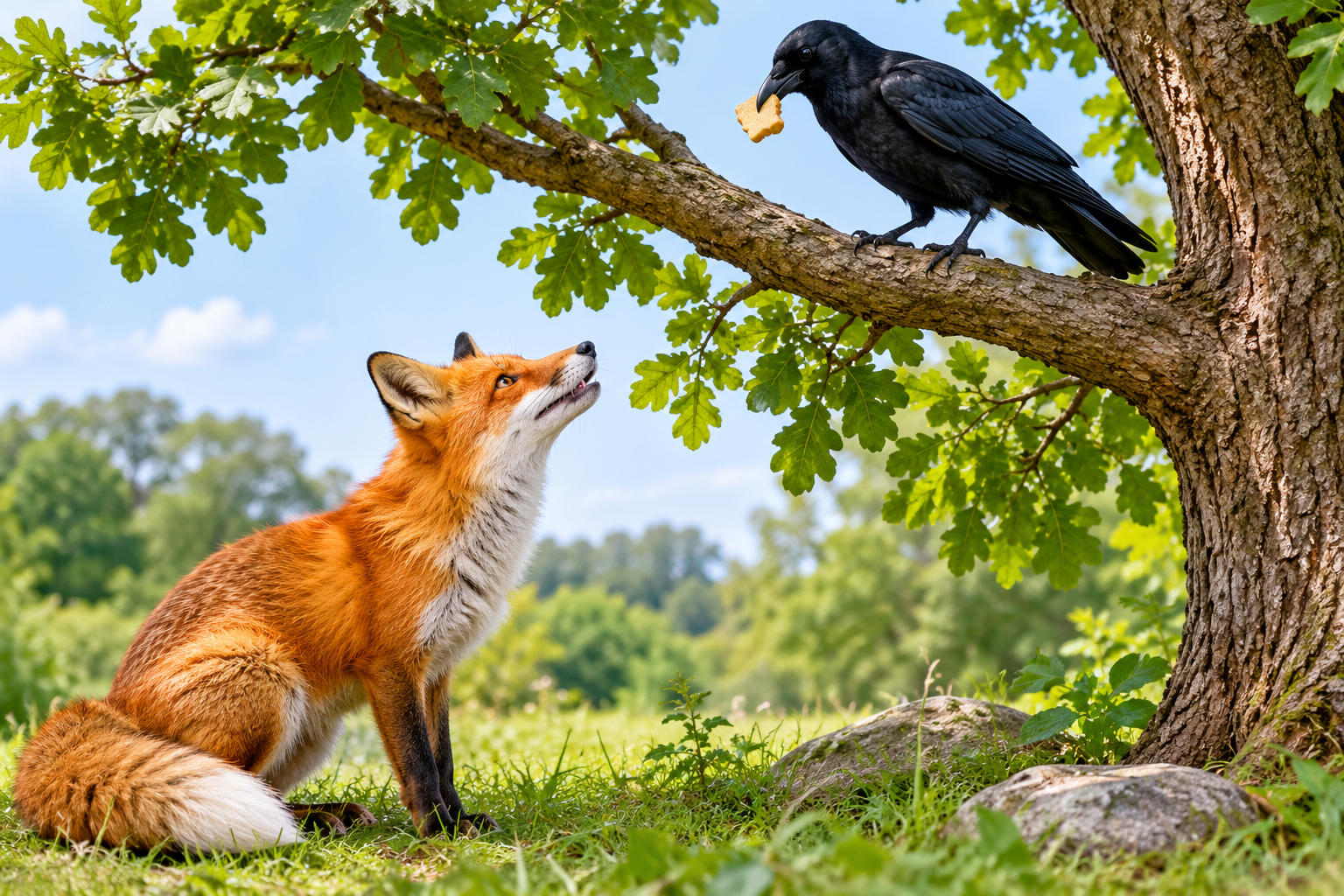
On a crisp spring morning in a leafy woodland near Richmond Park in London, a glossy black crow perched proudly on the branch of an ancient English oak. Clutched tightly in her beak was a thick wedge of mature Somerset cheddar cheese that she had rescued from a forgotten picnic basket.
Trotting along the mossy footpath below was Reynard the fox, who soon caught the savoury scent of the cheese. Now, there is an old stereotype in traditional tales that foxes are always cunning tricksters. Unfortunately for the crow, Reynard completely lived up to that reputation. He was determined to have that cheddar for his elevenses.
“Good morning, my fine feathered friend!” Reynard called up smoothly, displaying very human characteristics of flattery and deceit. The crow puffed out her chest, bursting with pride. She did not realise the fox was using an idiom—a clever figurative expression—when he beamed and declared, “You are truly the crown jewel of the woodland! I’ll bet you could sing the birds out of the trees!”
“If your voice is half as splendid as your shiny coat,” the fox added with an idiomatic expression of mock admiration, “you would be the talk of the town. Do sing just one verse for me!”
Eager to show off, the foolish crow lifted her head and opened her beak wide to let out a loud “Caw!” Instantly, the prized cheddar tumbled straight down into Reynard’s waiting jaws. The fox gulped it down and trotted off chuckling. The moral of this famous fable is crystal clear, echoing the old British proverb: “Never trust a flatterer.”
Put our Key Terms into action! Use the visual clues and definitions to complete each question.
Master the trickiest skills in Year 5 English: sorting literal vs. figurative language, decoding British proverbs, and challenging unfair stereotypes in stories.
Top Tip: A literal sentence means exactly what the words say. An idiom (or figurative expression) paints a vivid picture with a hidden meaning, while a proverb offers wise advice. A stereotype unfairly puts all characters into one fixed box!
In Aesop’s fables, animals often follow a fixed stereotype. Select the best way to rewrite each character so it challenges the traditional stereotype.
A fable is a short story, often featuring animals with human traits, that teaches a moral.
Proverbs are traditional sayings that give wise advice, such as “Never trust a flatterer” or “Slow and steady wins the race.”
An idiom (or idiomatic / figurative expression) means something different from its literal dictionary words.
We should spot and question stereotypes—oversimplified, fixed ideas about people or story animals.
Read this modern British retelling of another famous Aesop’s fable and answer the five assessment questions.
Barnaby the hare lived in a seaside village in Cornwall and loved boasting to the meadow animals about his speed. “I am as fast as lightning—winning will be a piece of cake!” he bragged, using his favourite idiomatic expression. One breezy Saturday morning, he challenged Timothy, a calm elderly tortoise, to a race down the lane to the Royal Mail post office.
When the whistle blew, Barnaby bolted ahead in a flash. Glancing back and seeing no trace of Timothy, Barnaby grinned and slipped into Mrs Higgins’s Tea Room. “I’ve got ages for a cream tea and scones,” he chuckled, ordering strawberry jam, clotted cream, and settling in for a cosy afternoon nap.
Meanwhile, Timothy plodded steadily past the stone cottages. Many animals held the stereotype that tortoises were too slow to achieve anything, yet Timothy showed admirable human qualities of patience and quiet determination. Step by steady step, he marched down the high street. By the time Barnaby jolted awake and sprinted breathlessly through the post office doors, Timothy was already at the counter, calmly posting his postcards to Edinburgh in Scotland.
Barnaby lowered his long ears in embarrassment. This lively fable had taught him an unforgettable moral, captured perfectly by the classic proverb: “Slow and steady wins the race.”
Tick each box as you feel confident with the skill: