
Chemistry: Grade 12 9 Sections46 Lessons7 Quizzes365 Days
1.5.1: Acid–Base Titrations
Acid-Base Titration
Chemistry 12th Grade
Lesson Competencies
At the end of this lesson you will be able to:
Define acid-base titration.
Distinguish between end point and equivalence point.
Explain the equivalents of acids and bases.
Calculate the normality of a given acidic or basic solution.
Suggest a suitable indicator for a given acid-base titration.
Discuss the different types of titration curves.
Key Terms
Titration
A quantitative chemical analysis method used to determine the unknown concentration of a solution.
Analyte
The solution in the flask whose concentration is unknown.
Titrant
The solution in the burette whose concentration is known (a standard solution).
Equivalence Point
The theoretical point in a titration where the moles of acid exactly equal the moles of base.
End Point
The experimental point in a titration where the indicator changes color, signaling to stop.
Indicator
A weak acid or base that changes color over a specific pH range.
Normality (N)
A unit of concentration defined as the number of equivalents of solute per liter of solution (eq/L).
Equivalent (eq)
The amount of a substance that can donate or accept one mole of H⁺ (in acid-base reactions).
Video Lesson
Core Lesson: The Chemistry of Titration
Dear learners,
imagine you have a bottle of vinegar (acetic acid) and you want to know its *exact* concentration. You can’t just look at it and know. Or, how does a quality control lab ensure a batch of medicine has the precise amount of active ingredient? The answer to both questions is a powerful chemical technique called titration.
Today, we will explore this process, learn the math behind it, and see how graphs can tell us the story of an acid meeting a base.
1. What is Acid-Base Titration?
Titration is a lab procedure used to determine the unknown concentration of a solution (the analyte) by reacting it with a solution of known concentration (the titrant or standard solution).
In an acid-base titration, we add a base to an acid (or an acid to a base) until the reaction is complete. This completion point is what we’re looking for.
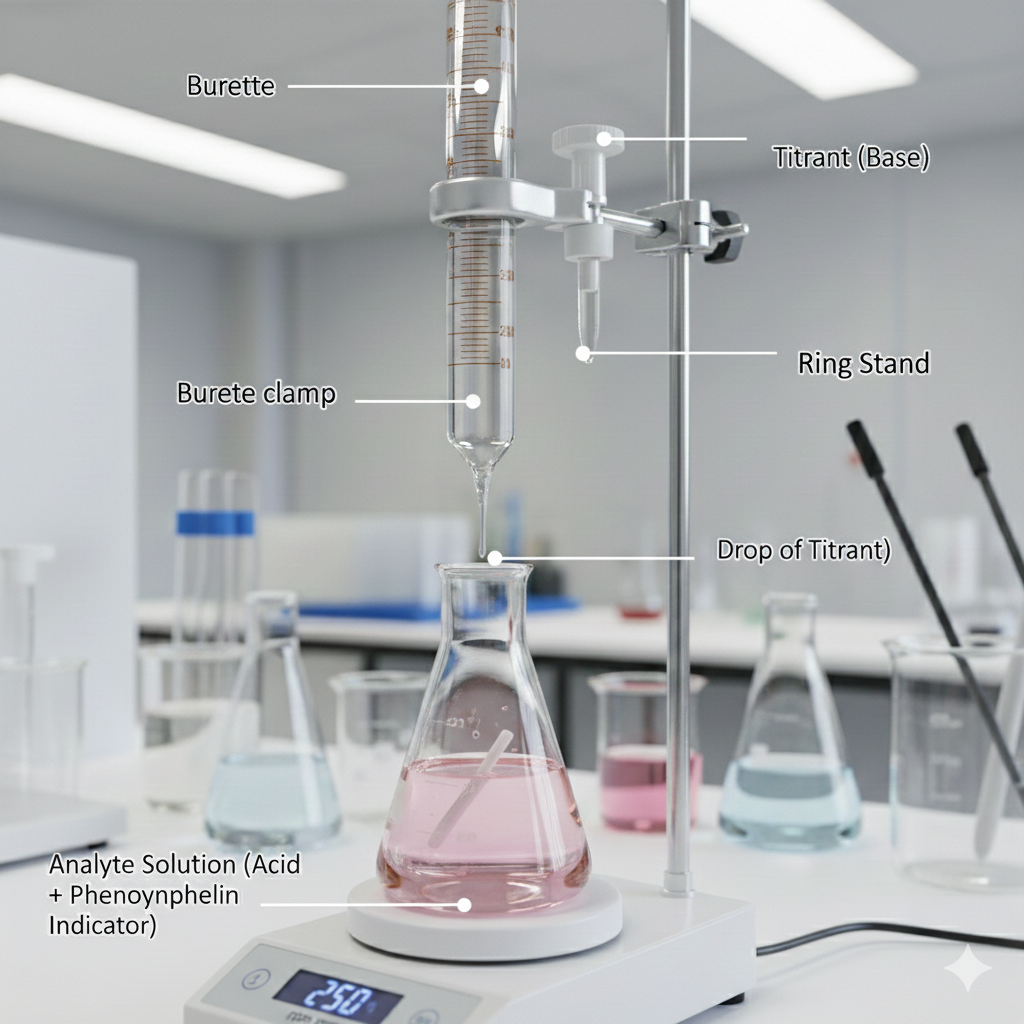
A typical titration setup. The titrant is in the burette, and the analyte is in the flask below, along with an indicator.
2. Equivalence Point vs. End Point
These two terms sound similar but are critically different:
- Equivalence Point: This is the theoretical point where the neutralization is chemically complete. The number of moles of H⁺ ions from the acid equals the number of moles of OH⁻ ions from the base.
At this point: (mathbf{moles of H^+ = moles of OH^-}) - End Point: This is the experimental point we observe in the lab. It’s when the indicator (a dye we add to the analyte) permanently changes color.
The goal of a good titration is to choose an indicator whose end point is as close as possible to the equivalence point.
3. Equivalents and Normality (N)
Molarity (M) is great, but for titrations, Normality (N) is often more direct. Normality is based on the concept of an equivalent (eq).
An equivalent is the amount of a substance that will donate or accept one mole of protons (H⁺).
- For HCl (monoprotic acid): It donates 1 H⁺. So, 1 mole HCl = 1 equivalent.
- For H₂SO₄ (diprotic acid): It donates 2 H⁺. So, 1 mole H₂SO₄ = 2 equivalents.
- For H₃PO₄ (triprotic acid): It donates 3 H⁺. So, 1 mole H₃PO₄ = 3 equivalents.
- For NaOH (monobasic base): It accepts 1 H⁺. So, 1 mole NaOH = 1 equivalent.
- For Ca(OH)₂ (dibasic base): It accepts 2 H⁺. So, 1 mole Ca(OH)₂ = 2 equivalents.
Calculating Normality
Normality is the number of equivalents per liter. The relationship with Molarity is simple:
(where (mathbf{n}) = number of equivalents per mole)
Example: What is the Normality of a 2 M H₂SO₄ solution?
(n = 2) (because H₂SO₄ has 2 H⁺)
(N = 2 M times 2 = 4 N)
The Titration Formula
At the equivalence point, the number of equivalents of acid equals the number of equivalents of base. This gives us the master formula for titration calculations:
(N = Normality, V = Volume, A = Acid, B = Base)
Calculation Example
Problem: It takes 30.0 mL of 0.50 N H₂SO₄ to neutralize 50.0 mL of an NaOH solution. What is the normality of the NaOH?
- Acid (A): (N_A = 0.50 N), (V_A = 30.0 mL)
- Base (B): (N_B = ?), (V_B = 50.0 mL)
Solution:
(N_A V_A = N_B V_B)
((0.50 N) times (30.0 mL) = N_B times (50.0 mL))
(15.0 = N_B times 50.0)
(N_B = frac{15.0}{50.0})
(N_B = 0.30 N)
4. Titration Curves
A titration curve is a graph of pH (y-axis) versus the volume of titrant added (x-axis). The shape of the curve tells us what kind of acid and base we are using.
1. Strong Acid – Strong Base (e.g., HCl + NaOH)
The pH starts very low, rises slowly, then shoots up vertically. The equivalence point is exactly at pH 7. Either Phenolphthalein or Methyl Orange works well.
2. Weak Acid – Strong Base (e.g., CH₃COOH + NaOH)
The pH starts higher (e.g., pH 3). There is a “buffer region” where the pH changes slowly. The equivalence point is above pH 7 (basic). We must use Phenolphthalein.
3. Strong Acid – Weak Base (e.g., HCl + NH₃)
The pH starts very high, drops, has a buffer region, then plummets. The equivalence point is below pH 7 (acidic). We must use Methyl Orange.
[Image of a strong acid-weak base titration curve]4. Weak Acid – Weak Base (e.g., CH₃COOH + NH₃)
These curves have no sharp, vertical change at the equivalence point. It’s very difficult to detect the end point with an indicator. These titrations are usually avoided.
Activity 1: Match the Terms
Drag the key terms from the bank on the left to their correct definitions on the right.
Terms Bank
Definitions
Activity 2: Check Your Understanding
Question 1: What is the Normality (N) of a 1.5 M solution of H₃PO₄?
Question 2: How many equivalents are in 1 mole of Ca(OH)₂?
Question 3: For a weak acid-strong base titration, the equivalence point will be…
Question 4: Which indicator is best for a strong acid-weak base titration?
Question 5: A “buffer region” is seen on the titration curve for…
Activity 3: Calculation Practice
Question 1: Complete the titration formula: (N_A times V_A = )
Question 2: What is the Normality of a 1.0 M solution of HCl?
NQuestion 3: What is the Normality of a 3 M solution of H₂SO₄?
NQuestion 4: 20 mL of 0.2 N acid is used to neutralize 40 mL of a base. What is the Normality of the base?
NQuestion 5: How many mL of 0.1 N NaOH are needed to neutralize 25 mL of 0.2 N H₂SO₄?
mLLesson Summary
Titration is a lab method to find an unknown concentration using a known one.
The Equivalence Point is the theoretical point where moles of acid = moles of base ((N_A V_A = N_B V_B)).
The End Point is the observed point where the indicator changes color.
Normality (N) is a useful concentration unit ((N = M times n)) where (mathbf{n}) is the number of equivalents (H⁺ or OH⁻).
Indicators are chosen based on the pH of the equivalence point (e.g., Phenolphthalein for WA-SB, Methyl Orange for SA-WB).
Titration curves (pH vs. Volume) show the titration’s progress and help identify the equivalence point and acid/base strength.
Final Assessment
Question 1: (True/False) The End Point and Equivalence Point are always the exact same pH.
Question 2: Why is a weak acid-weak base titration rarely performed?
Question 3: (Fill-in) 100 mL of 0.5 N base is neutralized by 20 mL of acid. What is the Normality of the acid?
NQuestion 4: You are titrating acetic acid (a weak acid) with sodium hydroxide (a strong base). Which is the BEST indicator to use?
Question 5: What is the Normality of a 0.5 M solution of Ba(OH)₂?
Competency Checklist
Review the goals from the start of the lesson. Check off the ones you feel confident about.